Visit our Library and download Free exclusive e-books — click to discover and begin reading.
What Is Oud Accord?
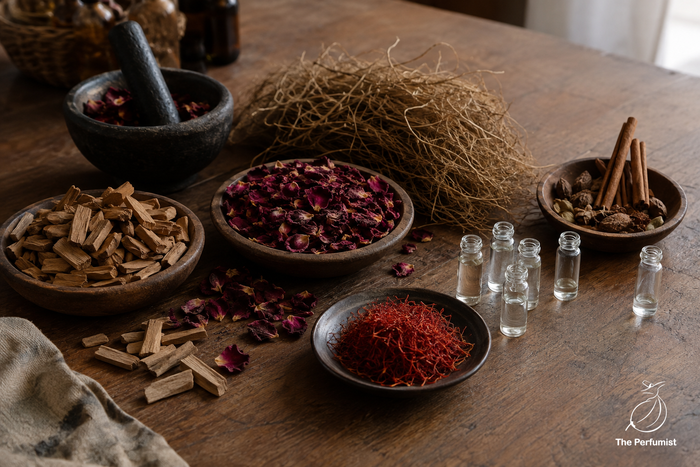
What Is Oud Accord? A Perfumer Explains What the Label Means
A perfumer comparing materials and blotters while building the impression of oud.

The question usually reaches me after someone has smelled two perfumes that both say “oud” and cannot understand why they seem to belong to different worlds. One is dark, damp, leathery and almost alive. The other is smooth, sweet, woody and immediately familiar. Both may be beautifully made. Both may be honestly described. Yet they are not necessarily made from the same thing.
The shortest answer is that oud is a natural aromatic material obtained from resin-rich agarwood, while an oud accord is a composition: several materials arranged to create an oud-like impression. That composition may contain real oud oil, a very small trace of it, or none at all. “Accord” describes the perfumer’s construction, not the botanical origin of every ingredient.
If you arrived here asking what is oud accord, this distinction is the place to begin. It prevents one of the most common misunderstandings in modern fragrance: a perfume can smell convincingly oud-like without being a presentation of natural oud oil.
The first time an oud label confused me
I remember smelling a polished Western fragrance whose name promised oud. It was attractive: dry cedar, amber, a little smoke and a clean leather effect. But I waited for the changes I know from natural agarwood oil—the damp opening, the shifting resin, the strange warmth that can move from bitter wood to skin, fruit, smoke and earth. Those changes never came.
That did not make the perfume bad. It made the word on the label incomplete. What I was smelling was an interpretation of oud, built to sit neatly inside a larger perfume. Once I understood that, the fragrance made sense on its own terms.
First, what does “accord” mean in perfumery?
Before an accord can imitate oud, the perfumer must understand the material it is interpreting.

An accord is a group of aromatic materials blended so that they create a new, recognizable impression. Think of a musical chord. You can identify the notes separately, but when they are played together you hear one shape. Perfumers work in much the same way with evaporation, texture and contrast.
A rose accord may combine floral, citrus, green, spicy and honeyed materials. An amber accord may join labdanum, vanilla-like warmth and balsamic materials. A leather accord can be built without putting a literal piece of leather into a bottle. The name tells you what the composition is intended to suggest.
An oud accord follows that same principle. It may combine woody, smoky, resinous, leathery, animalic, earthy, medicinal or ambery facets until the blend is perceived as “oud.” There is no single universal formula. One perfumer may make it dry and polished; another may lean into barnyard warmth; another may aim for a dark incense effect.
An accord is not one aroma molecule
People sometimes use “accord” and “synthetic note” as if they mean the same thing. They do not. A single aroma molecule is one material. An accord is the relationship between multiple materials. It can be entirely natural, entirely synthetic, or—most commonly in contemporary perfume—a mixture of both.
A perfume accord is therefore a structure, not a verdict on quality. In market language, a construction with no natural agarwood may be called synthetic oud, but that phrase still covers many possible formulas and levels of craftsmanship.
This matters because the words “oud accord” do not by themselves tell you whether natural agarwood oil is present. They only tell you that a perfumer has constructed an oud effect.
What natural oud actually is
Resin-rich agarwood has its own identity; the surrounding materials can echo only selected facets.

Natural oud begins with Aquilaria trees. Under particular biological conditions, the tree forms aromatic resin within the wood. That resin-rich agarwood can be burned as incense or distilled to produce oud oil. The oil is not merely “a woody smell.” It is the concentrated aromatic expression of a complex natural material.

One batch may smell damp, green and bitter at first, then reveal leather, warm skin, smoke and a quiet sweetness. Another may feel fruity, medicinal, mineral or almost floral. Origin, tree material, resin content, fermentation, water, distillation method, cut and ageing can all shape the result. Even oils from the same region can differ because nature does not work from a fixed perfume formula.

Why real oud keeps changing on the skin
Natural oud oil often unfolds rather than announcing one stable note. Volatile facets rise first; heavier resinous facets remain. Heat, skin chemistry and the quantity applied affect what you notice. A tiny swipe can move through several distinct stages over many hours.

This movement is one reason people who know natural oud can be surprised by a commercial oud perfume. An accord is usually designed for control. It must support the rest of the formula, behave predictably, meet a budget and give the wearer a clear idea quickly. Natural oud can be less obedient—and that unpredictability is part of its beauty.

How an oud accord is built
Traditional distillation produces natural oud oil; building an accord is a separate act of composition.

A perfumer usually begins by deciding which face of oud the fragrance needs. “Oud” is too broad a brief. Is the desired effect smoky or clean? Damp or dry? Animalic or polished? Bitter, sweet, leathery, medicinal, earthy, resinous or ambery? Should it dominate the perfume or appear as a shadow beneath rose, saffron, musk or amber?

The answer determines the palette. Cypriol or nagarmotha may add dry, smoky earth. Guaiacwood can give soft smoke and wood. Labdanum may bring ambery resin and leather. Patchouli can deepen the soil-like darkness. Cedar materials can create structure. Certain leathery or animalic materials suggest the difficult, feral edge found in some oud oils. Amber woods and musks can increase diffusion and make the effect last.

I am describing roles, not a recipe. A convincing accord depends on proportion, quality and restraint. Listing twenty materials does not make the result more truthful. Sometimes one material is doing too much and must be reduced until the rest of the structure can breathe.

The woody frame
The frame gives the accord shape. Cedar-like materials can feel dry and architectural. Sandalwood-like materials can make it creamy. Guaiacwood can connect wood to smoke. Patchouli can bridge polished wood and humid earth. Alone, none of these is natural oud; together, they can form a woody accord that prepares the nose to recognize an oud-like silhouette.

The resinous and smoky heart
Resins add density. Labdanum, benzoin, styrax-like effects and incense materials can supply balsamic warmth, shadow and persistence. Smoky materials must be handled carefully. Too much smoke and the fragrance becomes a bonfire; too little and the structure may feel like ordinary amber wood.

The leathery or animalic edge
Some natural oud oils carry facets that people describe as animalic, barnyard, cheesy, leathery or bodily. These descriptions sound unpleasant on paper, yet in a balanced oil they create depth and intimacy. An accord can suggest that tension with leather materials, indolic nuances, musks or minute animalic accents. The dosage is often tiny. The purpose is not to shock; it is to keep the wood from feeling flat.

The lift that keeps it wearable
Dark accords need air. Pepper, saffron-like spice, aromatic herbs, a faint floral note or a mineral brightness can lift the opening. Sweetness may round the edges. Musks may soften the drydown. This is where an oud accord often becomes easier to wear than a challenging natural oil: the perfumer can edit the experience.

Can an oud accord contain real oud oil?
A perfumer’s organ holds individual materials; the accord emerges only through proportion and relationship.

For readers asking what is oud accord, Laos Supreme offers a useful natural reference beside a composed oud impression.
Yes. An accord can contain natural oud oil. A perfumer may use real oud as the core and build around it, extending one facet or helping it connect to the rest of the perfume. Another formula may use a trace of natural oud for texture while most of the recognizable effect comes from supporting materials. A third may contain no natural oud at all.

That spectrum is why I avoid making conclusions from the word “accord” alone. It is a description of construction, not a percentage declaration. If natural oud matters to you, look for explicit language from the maker: the origin of the oil, the concentration, the distillation, or a clear statement that natural agarwood oil is used.

Why a perfumer might use both
Natural oud can add complexity that is difficult to imitate, while an accord can add consistency, projection or a specific direction. Combining them is not automatically a compromise. It can be a creative choice. The question is whether the brand explains the choice honestly.

Why many perfumes use an oud accord instead of natural oud
Evaluation on blotters reveals whether the accord reads as one idea or several disconnected materials.

Natural oud is rare, variable and expensive. A batch can be irreplaceable. A large fragrance house, however, may need to produce thousands of bottles that smell the same this year and next year. An accord makes that consistency easier.

There are also aesthetic reasons. A perfumer may want the suggestion of oud without its full force. A sweet rose perfume might need only a dark woody shadow. A fresh composition may need a clean, dry oud note that natural oil would pull in a more complicated direction. An accord lets the perfumer select the facets that serve the composition.
Safety, regulatory limits, sourcing documentation, availability and cost also influence formulas. The modern fragrance process includes evaluation of individual ingredients and their use levels; readers who want the industry overview can begin with what is oud accord. That does not tell you a specific brand’s formula, but it explains why a finished fragrance is the result of both creative and technical decisions.
Consistency is not the same as quality
People sometimes hear “synthetic” and assume “cheap,” or hear “natural” and assume “beautiful.” My nose does not accept either shortcut. A crude accord can smell harsh and generic. A refined accord can be elegant, transparent and technically impressive. Natural oud can be magnificent, but poor material, careless distillation or an unpleasant fermentation can still produce an oil someone does not enjoy.

Quality is revealed in the smell, the balance, the sourcing and the honesty of the description—not in one fashionable word.
Natural oud oil and oud accord side by side
Separate blotters make it easier to compare the pace and structure of each material.

|
Question |
Natural oud oil |
Oud accord |
|---|---|---|
|
What is it? |
Distilled aromatic oil from resin-rich agarwood |
A blend constructed to create an oud-like impression |
|
Is real agarwood required? |
Yes |
No; it may contain natural oud, a trace, or none |
|
Does it vary by batch? |
Often, because origin and distillation vary |
Usually designed for repeatability |
|
How does it smell? |
Complex, evolving and origin-dependent |
Focused on selected oud facets |
|
Typical role |
Worn alone, used in attar, or used within perfume |
Used as a note or structural base inside perfume |
|
Main strength |
Natural complexity and individuality |
Control, consistency and creative flexibility |
The table is useful, but it cannot replace smelling. Some accords are deliberately wild; some natural oils are surprisingly smooth. Categories help us ask better questions, not predict every bottle.
What does oud accord smell like?
The character depends on which woody, smoky, resinous and animalic facets are emphasized.
There is no single smell. In mainstream perfumery, oud accord often means a dark woody base with amber, smoke, leather and sweetness. It may be cleaner and more linear than natural oud oil. In niche perfume, it might become medicinal, tarry, mineral, fungal or animalic. In a rose-oud composition, it may act as a dry shadow beneath the flower. With saffron and amber, it may feel plush and radiant.
I listen for texture as much as scent. Does the accord feel polished like lacquered wood, rough like bark, damp like forest soil, or dense like resin? Does it expand from the skin or sit close? Does the sweetness cover the wood, or does the wood hold its shape into the drydown?
Why some oud accords smell familiar
Many modern formulas share popular amber-woody materials. When those materials dominate, different “oud” fragrances can feel related even if their openings differ. The result is powerful and long-lasting, but it may say more about the current amber-wood style than about natural agarwood.
That familiarity is not necessarily deception. It becomes a problem only when a broad marketing story encourages the buyer to imagine rare natural oil where none is claimed or disclosed.
How I compare an accord with natural oud
Labdanum can contribute resinous darkness and leathery warmth without pretending to be oud by itself.

I do not begin by asking which one is stronger. Strength can be created in many ways and tells me little about authenticity. I compare them on clean blotters first, then on skin. I smell immediately, after fifteen minutes, after an hour and much later in the drydown.

Natural oud often gives me transitions I did not predict. An accord usually reveals a clearer design: the perfumer has selected the beginning, middle and ending. I also smell the empty space around the material. Natural oil can contain strange contrasts—brightness inside darkness, sweetness inside bitterness—that are difficult to reproduce by stacking obvious “dark” notes.
Step 1: Smell without reading the story
Marketing language can lead the nose. I smell first and read later. I write simple impressions: dry, damp, sweet, smoky, medicinal, leathery, radiant, soft, linear, changing. This keeps me from repeating the brand’s adjectives back to myself.
Step 2: Watch the transitions
I return to the blotter instead of deciding in the first minute. If the scent moves through distinct textures, I note how and when. If it remains stable, I ask whether that stability serves the perfume. A linear accord can be exactly right beneath a complex floral heart.
Step 3: Test a modest amount on skin
Natural oud oil is concentrated; more is not always more informative. A small application lets the material open without overwhelming the senses. For an alcohol-based fragrance, I use a normal spray and allow the alcohol to evaporate before judging the heart.
Step 4: Ask the maker precise questions
Instead of “Is this real oud?” I ask: Does the formula contain natural agarwood oil? From which region? Is “oud” being used as a note description or an ingredient claim? Is the product a pure oil, an attar, an elixir or an alcohol-based perfume? Clear questions make clear answers possible.
How to read an oud perfume description
Separate natural materials begin to read as one idea only when their proportions meet.

A note list is not an ingredient list. When a perfume page lists “oud” beside rose, saffron and amber, it may be describing the smell the perfumer wants you to perceive. It does not automatically prove that natural oud oil is present, just as a “leather note” does not prove the formula contains leather.
Look for specific, verifiable language. “Oud accord,” “oud note” and “oud effect” normally describe the olfactory idea. “Natural oud oil,” “agarwood oil” or a named origin is more specific, but I still look for context. Serious natural-oud descriptions often discuss batch, region, distillation or material character because those details matter to the product.
Three phrases that are not interchangeable
- Oud oil: normally indicates oil distilled from resin-rich agarwood, though the seller should still explain purity and origin.
- Oud accord: a constructed blend intended to smell oud-like; natural oud may or may not be included.
- Oud perfume: a finished fragrance in which oud is part of the identity; the formula may use natural oud, an accord, or both.
Sustainability and the reason transparency matters
A working archive preserves material character, formulas and sensory decisions across generations.

Agarwood’s rarity is not merely a luxury story. It creates responsibility. Buyers should care about lawful sourcing, species protection, traceability and whether the material is wild, cultivated or supported by credible documentation. An accord can reduce dependence on scarce natural material, although it does not automatically make an entire perfume sustainable. The full formula, manufacturing and packaging still matter.
Transparency also protects language. If every dark amber-wood perfume is presented as though it contains a treasure of natural oud, the public loses the ability to recognize what natural agarwood oil actually offers. We can respect creative accords and protect natural oud at the same time by naming each honestly.
Is an oud accord fake oud?
Modern composition can recreate selected oud facets with precision, consistency and control.

I would not use “fake” as the automatic answer. An accord is a normal perfumery technique. It becomes misleading only when the presentation makes a material claim the formula cannot support. A painter’s portrait is not a fake person; it is an interpretation. But the gallery should not label the portrait as the person himself.
The same fairness should apply here. If a brand says it created an oud accord, it is telling you that the smell was composed. Judge the composition as a composition. If a brand promises pure natural oud oil, then origin, purity and craftsmanship become central to the judgment.
When an accord may be the better choice
Choose an accord when you want a predictable oud effect inside an easy-to-wear fragrance; when you prefer low animalic intensity; when you want strong projection; or when the pleasure of the complete perfume matters more than owning a rare natural material.
Choose natural oud oil when you want to study agarwood itself: its origin, texture, development and individual batch character. Neither choice needs an apology. They answer different desires.
Where attar fits into the conversation
Skin evaluation reveals how a composition settles after its brighter materials have faded.

An attar is itself a composition, traditionally oil-based and made without the structure of a conventional alcohol spray. An oud attar may use natural oud oil alongside rose, musk, amber, spice or other botanical materials. It can therefore be both natural-material perfumery and an accord-driven artistic work.
The useful question is not whether a product has more than one ingredient. The useful question is what those ingredients are doing. Is the oud being presented as a single-material oil? Is it part of an attar? Is it one note in an alcohol-based perfume? The format and the claim should agree.
My practical buying checklist
Before buying, I would ask five things:
1. Does the maker say “natural oud oil,” “oud accord,” or simply “oud note”?
2. If natural oud is claimed, is an origin or batch identified?
3. Is the product a pure oil, an attar, an elixir or an alcohol perfume?
4. Do the description and price make sense together?
5. Can I sample it and follow the drydown on my own skin?
I would also be cautious with absolute statements. “Synthetic” does not mean weak. “Natural” does not mean universally pleasant. “Oud” on the front of a box does not reveal the formula. A sample, a clear maker and an attentive nose will teach you more than a dramatic name.
The distinction I want you to remember
The final judgment comes after the drydown, when the construction has had time to reveal itself.

Natural oud is a material. Oud accord is an idea built from materials. Sometimes the two meet in the same formula; sometimes they do not.
Once you understand that, fragrance descriptions become easier to read. You can appreciate the controlled beauty of a well-made accord without mistaking it for a pure distillation. You can also approach natural oud oil with the patience it deserves, expecting variation, movement and character rather than a standardized “oud smell.”
For me, honesty is the luxury. A perfumer should be free to create an interpretation, and a customer should be able to understand what is being offered. When the language is clear, there is room for both: the rare voice of agarwood itself and the human art of composing its echo.
— Ali Attar