Visit our Library and download Free exclusive e-books — click to discover and begin reading.
The Tree Of Life - Chapter Four - The Immortal
Chapter IV - Bali: The Tree That Remembered

The 700-Year-Old Banyan Giant
Bali, Indonesia
By the time I arrived in Bali, I had already traveled across multiple countries, collected samples from some of the most remarkable trees I had ever encountered, accumulated notebooks full of observations, and given my chemist enough material to keep him occupied for months.
I should have been tired.
Instead, I was energized.
There is something about a project that slowly transforms from an idea into an obsession.
This way not my project this was a legacy and history for the world of perfumery to keep or at least try.
At some point, you stop asking whether it is practical.
You stop asking whether it is efficient.
You stop asking whether it makes sense.
You simply continue because you have become invested in the journey itself.
That is where I found myself.
Bali felt different from the moment I arrived.
Some places feel modern.
Others feel historic.
Bali felt timeless.

There were moments when I genuinely felt as though I had stepped into another century.
And there were other moments when it felt less like reality and more like a scene from a fantasy film.
Ancient trees.
Dense jungle.
Temples.
Offerings.
Incense.
Nature.
Everything seemed interconnected.
It was beautiful.
But before I continue, there is a part of the journey I have not mentioned.
A part that nearly ended it.
At first, I assumed I was simply exhausted.
After all, I had spent weeks traveling, walking, researching, collecting samples, visiting remote locations, sleeping irregularly, and constantly moving from one destination to another.
Fatigue seemed reasonable.
So, I ignored it.
That turned out to be a mistake.
What began as tiredness quickly became something much more serious.
The weakness increased.
The exhaustion intensified.
Something was wrong.
Unfortunately, I happened to be staying on a small island where there were no cars.
No taxis.
No emergency vehicles rushing through traffic.
Transportation consisted primarily of bicycles, a few motorcycles, and the occasional horse cart.
Not exactly ideal circumstances for a medical emergency.
As my condition worsened, I eventually got onto a bicycle and began making my way toward the nearest medical facility.
With blurry vision and, barley pushing my body to move, I was severely dehydrated, and very sick!
Looking back, the entire experience feels surreal. One moment I was searching for ancient trees.
The next I was racing toward a hospital on a bicycle.
The funniest part is that people around that island where there to party! It’s funny how thing greatly change in prospective!
When I arrived, the doctors immediately admitted me.
After a series of examinations and tests, they informed me that I was suffering from severe poisoning.
The doctor explained that had I arrived only a few hours later, the outcome could have been very different.
That is the polite medical version. The less polite version is that I nearly lost my life.
Lying in a hospital bed on a tropical island thousands of miles away from home was certainly not part of my original itinerary. Needless to say, neither was poisoning.
Fortunately, I recovered.
Looking back now, I do not remember fear as much as I remember frustration.
Not because I was in a hospital.
Because I still had trees to visit.
I still had notes to write.
I still had scents to study.
And I still had a project to complete.
Common sense would probably suggest that nearly losing your life is a good reason to slow down.
In hindsight, common sense may have had a valid point.
But after recovering or feeling better! I returned to the journey, like two days after
Some projects become difficult.
Others become personal.
By that point, this project had become both.
Looking back now, I sometimes wonder if the trees taught me something before the perfume ever did.
Endurance is easy to admire from a distance.
It becomes much harder when life asks it of you directly.
After recovering, our guide took us deep into the jungle in search of agarwood trees.
I had been on similar hunts before.
The odds are not particularly encouraging.
Finding a truly exceptional tree in the wild is a little like looking for a needle in a forest.
But the journey itself often becomes the reward.
Hours passed.
We walked through dense vegetation, crossed difficult terrain, and searched areas where trees had stood for generations. Snakes and scorpions are your least worries in the jungle.
Eventually, we decided to call it a day.
I was tired.
Still recovering.
And desperately in need of hydration.
So, I began walking toward a nearby local shop.
That is when I saw it.
A tree.
At least technically.

But calling it a tree felt inadequate.
It felt less like a tree and more like an ecosystem living in the middle of concrete, breaking every rule and quietly reminding everyone that nature always prevails.
The roots seemed to have negotiated a peaceful agreement with the surrounding city. Much better than many countries in our time.
The branches stretched outward as though they owned the street.
And somehow, they probably did.
I stopped immediately.
Nearby stood an elderly man who spoke excellent English.
I greeted him and pointed toward the tree.
"Sir," I asked, "that is a beautiful tree. Can you tell me anything about it?"
The man smiled.
Then he smiled even more after discovering I was interested in trees.
That usually happens.
Most people ask about restaurants.
Or beaches.
Or shopping.
Or Clubs.
Very few tourists arrive asking questions about trees.
He seemed pleased by the change of pace.
What followed was one of the most memorable conversations of the entire journey.
He explained that many trees in Bali were considered sacred by local communities.

Not all of them.
But some.
Particularly the older ones.
The trees connected to temples.
The trees connected to local history.
The trees connected to stories.
Then he pointed directly at the one standing before us.
"This tree," he said, "is one of them."
After a brief pause, he continued.
"I will tell you a story."
The old man explained that many years earlier, a wealthy friend of his had purchased land containing a similar tree. The architect responsible for the project recommended preserving it.
The tree would not interfere with construction. In fact, it could become the centerpiece of the entire property.
But the owner disliked the tree.
He simply wanted it removed.
The old man pleaded with him.
Not because of engineering.
Not because of architecture.
But because local generations had long respected the tree. He believed it should remain.
The owner laughed.
Old folklore!

Promised he would leave it alone.
And then cut it down anyway.
The old man paused for a moment before continuing.
A few days later, he said, he received news that his friend had died unexpectedly in his sleep.
Passing by the property afterward, he noticed that the tree had already been cut down.
Whether the two events were connected or not, the old man firmly believed they were.
And after all these years, he still spoke of that story as if it had happened yesterday.
He told me people think I’m superstitious or not educated but I know what I’m talking about. He said I know you will never tell that story to anyone because you think I’m crazy and probably people will think you are crazy for telling it. With a smile I told him you have my word I will say just like you said it in my journal and travel story, after all if everything is believable and make sense where is the fun is in visiting ancient and mystical places.
I thanked him for sharing it.
I also assured him that I had no plans to cut any trees anytime soon.
Quite the opposite.

I was trying to celebrate them.
That seemed to make him happy.
Before leaving, I asked whether he knew of any other remarkable trees nearby.
His eyes lit up immediately.
He pointed toward a distant area and gave me directions.
"There is another tree," he said.
"A very old one."
"How old?"
He laughed.
"It was already old when my grandfather was a child." Like really Old!
That was all the encouragement I needed.
The following morning, I packed a backpack with water, snacks, notebooks, and enough supplies to satisfy both common sense and my recent medical history.
Then I headed out.
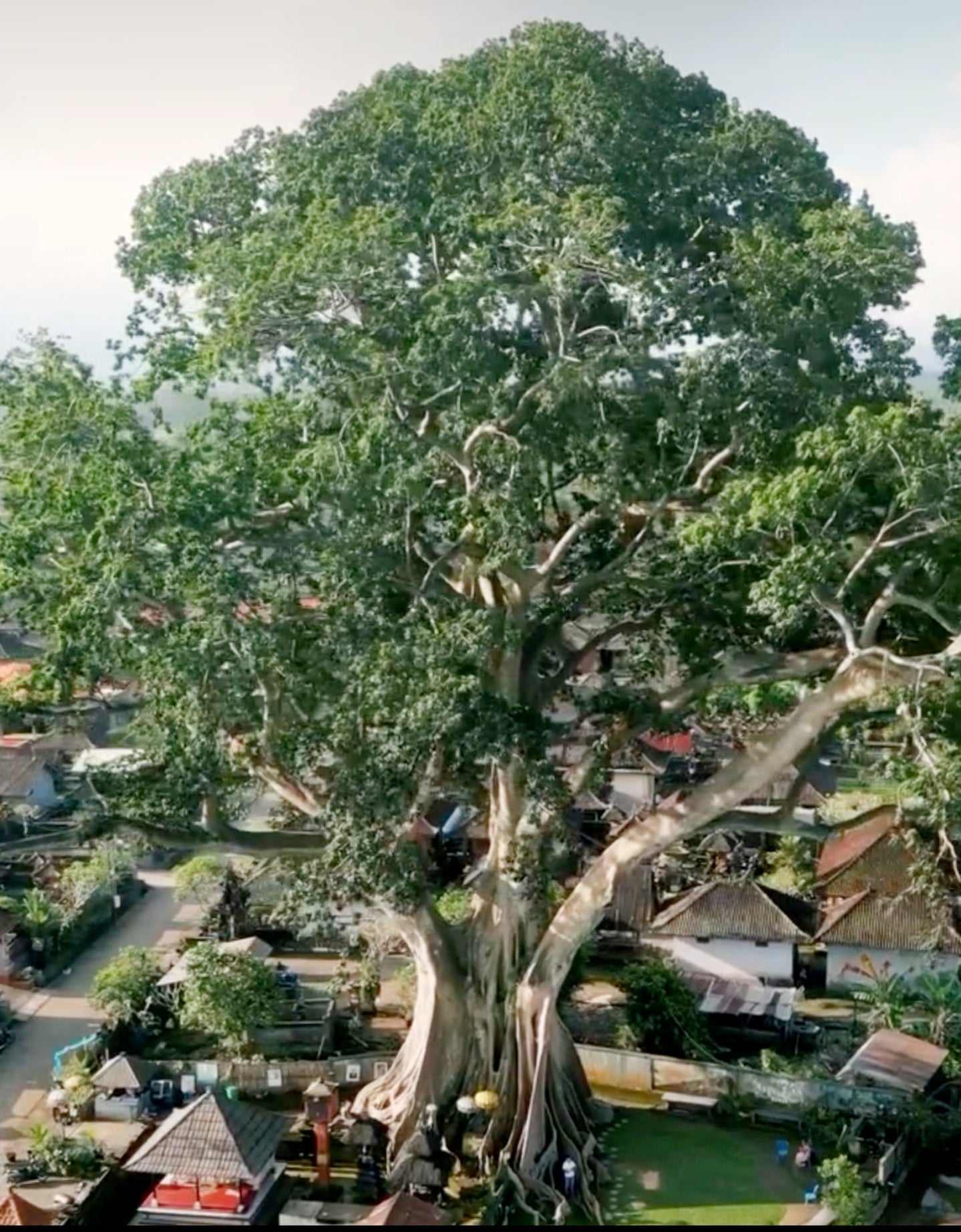
Eventually I found it.
The tree shown in the photographs accompanying this project.
It was enormous.
Ancient.
Different.
There was something about its aroma that felt timeless.
Perhaps it was the soil.
Perhaps it was the climate.
Perhaps it was centuries of life slowly written into the wood itself.
Or perhaps it was all of those things together combined.
I collected a small branch and several leaves.
And yes.
They also went to the laboratory.
Again.

At this point, both the laboratory and my chemist had probably stopped asking questions entirely.
The older the tree, the more it seemed to remember. Standing beneath it was a humbling experience.
Later, I visited another ancient tree in Bali that looked less like a tree and more like something from a science fiction film. The scale alone was enough to remind me how small human beings really are.
For the first time during the journey, I could not reach any branches.
The tree had won.
So, I collected a small piece of naturally fallen bark from the ground.
No laboratory required.
No sample extraction.
No complicated analysis.
Just observation.
The flowers left a special memory it was a holiday or some sort of a religious event, there were small boxes of flowers all over the streets with sticks of incense, and the jungle and the city shared everything in harmony there was no conflict, the people sitting in a modern shop on their smart phones and cross the street monkeys coming down from the trees picking up food and flowers. Literally, and I recorded it!
You are probably laughing by now.
That is understandable.
But this is the life of a perfumist.
And honestly, I cannot imagine a more beautiful one.
As I left Bali, I carried more than samples.
I carried perspective.
The trees had already begun teaching me lessons that extended far beyond scent.
At the time, however, I still believed the hardest part of the project was behind me.
I was wrong.
Because returning home would reveal the most difficult challenge of all. Recreating the memories.