Visit our Library and download Free exclusive e-books — click to discover and begin reading.
The Tree Of Life - Chapter Six - The Lesson
Chapter VI - Recreating Memory
When I finally returned home, many people assumed the difficult part of the project was over.
In reality, it had only just begun.
The travel was challenging.
The research was demanding.
The poisoning was certainly memorable.
But none of those things proved as difficult as recreating what I had experienced.
By the end of the journey, I had accumulated branches, leaves, notebooks, photographs, laboratory reports, sleepless nights, a hospital stay, and more questions than answers.
Now came the real challenge.
Turning those experiences into scent.
At first, the process appeared straightforward.
I had samples.
I had laboratory analyses.
I had notes.
I had photographs.
I had observations.
I had memories.
I had years of experience.
Surely that would be enough.
It wasn't.
The first reconstruction failed.
Not technically.
Emotionally.
The chemistry was correct.
The structure was correct.
The laboratory data was correct.
Yet the scent felt completely wrong.
It smelled like a formula.
Not a memory.
So, we started again.
Then again.
And again.
And again.
Eventually the number of attempts exceeded one hundred.
Some versions were unpleasant.
A few were genuinely terrible. Like terrible enough that I totally crossed from the notebook.
Others were so faint they seemed to disappear almost immediately after application.
Several smelled impressive from a technical perspective but lacked character, didn’t evolve.
Or longevity, or projection, or evolution, or depth, when you are making perfume of the level and expectation for such a project you are not making a scent you are making an aura.
Some smelled kind of beautiful. And that became a problem.
Because the trees themselves were not simply beautiful.
They were alive.
There is a difference.
Beauty can be manufactured.
Life cannot.
Authenticity!
At one point, after yet another failed reconstruction, I remember sitting in front of a table covered with notes, formulas, samples, and laboratory reports, and a trash can filled or used paper strips and drippers.
The chemist sat across from me.
Both of us staring at the latest version.
Neither of us particularly impressed.
The laboratory had done its job.
The chemistry was correct.
The analysis was correct.
The proportions were correct.
The layering was correct.
Yet somehow the scent remained wrong.
That was the moment I realized we were solving the wrong problem.
We thought we were trying to recreate scents.
We weren't.
We were trying to recreate memories.
The laboratory could identify molecules.
It could identify aromatic compounds.
It could identify structures.
What it could not identify was the feeling of standing beneath a centuries-old tree while rain fell softly across a temple courtyard.
It could not identify the faint traces of incense drifting through the air.
It could not identify silence, when it smells like grass or a rainy quiet field.
It could not identify history, or legacy in a shrine or a temple with cedar wood alter.
It could not identify wonder, mystery and depth.
And yet those things were part of the scent.
Perhaps they were the most important part or the only part that matter.
That realization changed everything.
Until that point, we had been approaching the project as chemists and perfumists.
Now we began approaching it as storytellers.
Memory became the focus.
Emotion became the focus.
Atmosphere became the focus.
Leave the lab test and use your nose, I told myself
The feeling, the memory and the sensation.
At some point, the project stopped being about whether we could recreate the scent.
The question became whether we could recreate the memory and the feeling.
That distinction sounds small.
It is not.
One evening, after another failed attempt, someone suggested what many modern fragrance houses would probably consider the obvious solution.
Synthetics.
The suggestion was reasonable, actually logical
Practical.
Efficient.
And in many ways, correct.
Some synthetic materials can reproduce certain aromas with astonishing accuracy.
In some cases, the resemblance is remarkable, with some naturals this can be a winner.
Perhaps convincing enough for most people.
But we are not making this for most people, most people probably think our oils more suitable for a monk, a yogi, or a rebel than it is for someone in a metropolitan. Our entire year production is less that one single shelves in a large department store.
But I knew something was missing.
A synthetic reconstruction can imitate a scent.
It cannot become the scent.
That is not a criticism.
It is simply a limitation.
The best comparison I can offer is this:
Imagine someone you deeply care about.
Now imagine looking at a photograph of them.
The photograph may be perfect.
It may capture every detail.
It may remind you of them immediately.
That’s’ them in front of you
Yet it is not the person.
It does not carry their presence.
Their character.
Their energy.
Their humanity.
It is a reminder.
Not the experience itself.
The same is true of scent.
A synthetic accord may remind you of a tree.
It may even smell remarkably similar.
But it cannot fully reproduce the atmosphere, depth, complexity, and living character that made the original experience unforgettable.
It becomes a bridge to the memory rather than the memory itself.
And while bridges are useful, they are not destinations.
That realization forced us to rethink the entire project.
The first reconstruction failed.
The second smelled technically correct but emotionally wrong.
The third smelled like a perfume.
The tree did not smell like a perfume.
The tree smelled alive.
That was the challenge.
And that was the lesson.
Some things cannot be copied.
They can only be honored.
The closer we came to understanding that truth, the closer we came to creating something meaningful.
Months passed.
Then more months.
The project evolved.
Changed.
Improved.
Failed.
Improved again.
Failed miserably!
And hope! Whenever and wherever, there is hope there are possibilities
At times it felt less like creating a fragrance and more like translating a language.
How do you translate silence?
How do you translate history?
How do you translate reverence?
How do you translate standing beneath a tree that has witnessed centuries of human life?
You don't.
At least not perfectly.
You do your best.
And then you keep trying.
One of the people who helped tremendously during this process was a close friend of mine, a French perfumist whose expertise in simulating natural materials far exceeds my own in certain areas.
I owe him a great deal of credit.
Many of the refinements that ultimately shaped the project came through discussions with him.
Conversations that often lasted far longer than either of us expected.
There were also chemists.
Laboratory technicians.
Researchers.
Experts from different disciplines.
Each contributed something important.
The final scent was not the result of one individual.
Mater Ali Attar didn’t create this, I barley discovered it
It was the result of many people helping bring an idea into reality.
Yet despite all of the science, all of the analysis, all of the expertise, the most important lesson remained surprisingly simple.
The laboratory could identify what was present.
Experience could identify what was missing.
And what was missing was often the most important part.
Eventually, after more than one hundred attempts, something changed.
The scent in front of us was no longer merely accurate.
It felt familiar.
Not because it perfectly replicated any one tree.
That would have been impossible.
But because it captured something larger.
A feeling.
A mood.
A memory.
The silence of a temple.
The resilience of an ancient tree.
The reverence of a monk.
The history of a battlefield.
The humility of standing beneath something older than yourself, and your parents.
For the first time since the project began, I stopped thinking about formulas.
I stopped thinking about molecules.
I stopped thinking about chemistry.
Instead, I found myself remembering the journey.
And that was the moment I knew we were finally close.
Not to recreating the trees. You can’t
To honoring them.
The project was never about copying nature.
It was about paying respect to it.
And with that realization, the final chapter began.
The Tree of Life. The Miracle!
The Lesson - The Tree of Life
By the time the final scent was complete, I realized something unexpected.
The project had changed.
Or perhaps I had.
What began as a search for remarkable trees had become a search for something much deeper.
Meaning.
Memory.
Connection.
Perspective.
At the beginning, I believed I was traveling to learn about trees.
Looking back, I think the trees were teaching me about people.
Every tree I encountered told a different story.
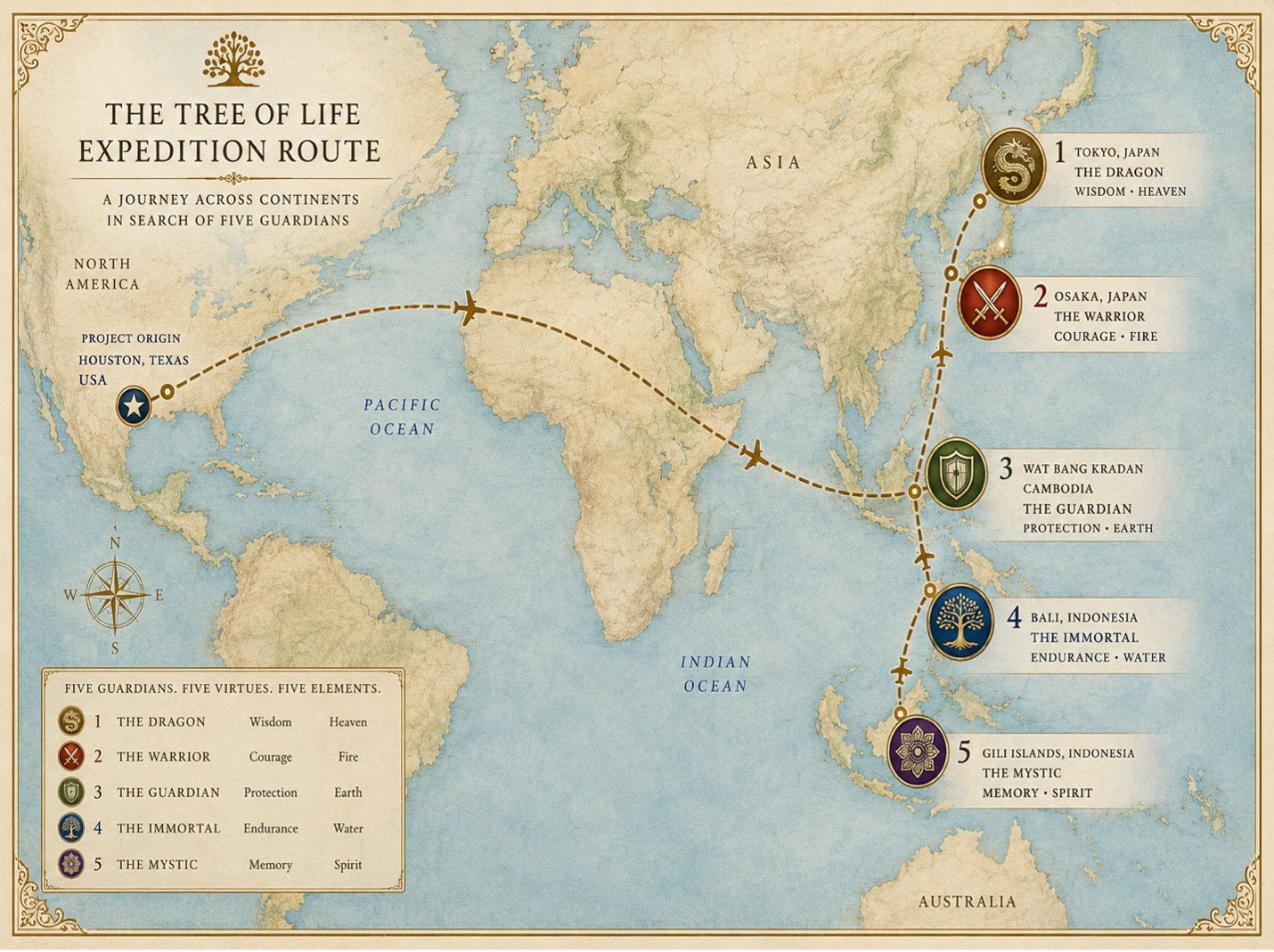
The Dragon Tree in Japan taught me about reverence.
The Camphor Tree in Osaka taught me about memory.
The Guardian Tree in Cambodia taught me about protection.
The ancient trees of Bali taught me about endurance.
Different countries.
Different cultures.
Different histories.
Different species.
Yet somehow, they all seemed to be communicating the same lesson.
That we are not separate from nature.
We are part of it.
And it is part of us.
Modern life often encourages us to think otherwise.
We build cities.
We build roads.
We build technology.
We surround ourselves with conveniences that make it easy to forget where everything begins.
Yet every piece of wood once grew from a tree.
Every breath we take depends upon living ecosystems.
Every civilization in human history was built upon the resources nature provided.
Whether we acknowledge it or not, our relationship with the natural world remains one of the most important relationships we have.
And yet it is often one of the most neglected. One of the most abused.
Perhaps that is why trees have always fascinated me.
A tree asks for very little.
A little sunlight.
A little water.
A little time.
In return, it spends its entire life giving.
Shade.
Oxygen.
Fruit.
Shelter.
Beauty.
Art.
It gives continuously without asking who deserves it.
Without asking who agrees with it.
Without asking who will benefit from it.
It simply gives.
There is something profoundly noble about that.
As the project evolved, I found myself thinking more and more about a concept that appears throughout cultures, philosophies, and spiritual traditions around the world.
The Tree of Life.
Different civilizations describe it differently.
Different religions interpret it differently.
Different cultures tell different stories.
Yet the symbolism remains surprisingly consistent.
Growth.
Connection.
Wisdom.
Continuity.
Life itself.
That symbolism became increasingly meaningful to me.
Because within each of us there is a tree.
A tree of goodness.
A tree of courage.
A tree of resilience.
A tree of compassion.
A tree of love.
And like any tree, it requires nourishment.
If neglected, it weakens.
If cared for, it grows.
Not only for ourselves.
But for everyone around us.
Families.
Friends.
Communities.
Future generations.
Humanity.
When a man plants a tree, he may do so for its fruit.
But a truly great tree does not choose who receives its shade.
It offers it freely.
To everyone.
Think about that.
The older I become, the more I appreciate that lesson.
Some of the greatest people I have encountered in life share this quality.
They create.
They teach.
They build.
They contribute.
Not because they expect something in return.
But because they understand that what they leave behind matters.
The same principle applies to art.
At its highest level, art is an act of generosity.
It allows one person to share an experience or a vision with another.
A thought.
A feeling.
A memory.
A perspective.
Perhaps that is why I became a perfumist.
Scent is one of the few artistic mediums capable of bypassing logic entirely and speaking directly to mind and memory.
A photograph can remind you of a place.
A song can remind you of a moment.
A scent can transport you there.
Instantly.
Without warning.
Without permission.
A single aroma can reconnect someone to a childhood memory they have not thought about in decades.
That is extraordinary.
And that possibility is what motivated this project from the beginning.
Not the perfume.
The connection.
The opportunity to preserve something meaningful and share it with others.
Over the course of this journey, I traveled through multiple countries.
Visited temples.
Explored forests.
Spoke with monks.
Listened to historians.
Collected samples.
Survived a hospital stay.
Worked with chemists.
Obsessively made trials.
Collaborated with fellow perfumists.
And failed more times than I can comfortably count.
Every step contributed something.
Every mistake taught something.
Every challenge improved something.
None of it was wasted.
Looking back, I realize that many of the most valuable lessons had very little to do with fragrance.
They were lessons about patience.
Humility.
Respect.
Curiosity.
Perseverance.
And perhaps most importantly, appreciation.
Appreciation for places.
Appreciation for traditions.
Appreciation for people who dedicate their lives to preserving things that might otherwise disappear.
Because preservation is ultimately what this project became about.
Not preserving trees physically.
Not preserving history academically.
But preserving memory.
And sharing it.
That, in many ways, is what art has always done.
It allows one generation to leave something behind for the next.
A story.
A painting.
A song.
A sculpture.
A book.
A fragrance.
A seed.
A scent.
The medium changes.
The intention remains the same.
To leave something meaningful behind.
To contribute.
To create.
To inspire.
And if this project succeeds in doing even a small amount of that, then every mile traveled, every sleepless night, every failed formula, every laboratory report, every setback, and every challenge, and hundreds of thousands of dollars will have been worth it.
Because the goal was never perfection.
The goal was connection.
And perhaps that is the most important lesson the trees taught me.
Not how to create a fragrance.
But how to create something that matters.
The journey itself may have come to an end.
The lessons, however, continue to grow.
Much like the trees that inspired them.
Let scent be a reminded of who you are, and you want to be, and most importantly what you want to leave behind in legacy and beauty in the world.
What I Brought Home
People often ask me what I brought back from the journey.
The answer depends on how you measure such things.
If we are speaking literally, then the answer is simple.
A few branches.
A handful of leaves.
Several notebooks.
Laboratory reports.
Countless photographs.
And lots of incense.
And a collection of memories that will remain with me for the rest of my life.
But if we are speaking honestly, I brought back something else.
Perspective.
When this project began, I believed I was searching for remarkable trees.
Ancient trees.
Rare trees.
Historic trees.
Sacred trees.
And I certainly found them.
What I did not expect was how much they would teach me in return.
The Dragon Tree taught me that some things deserve reverence.
The Camphor Tree taught me that history leaves traces in places long after the people who created it are gone.
The Guardian Tree taught me that value and price are not the same thing.
And Bali taught me that endurance is not merely something we admire in nature.
Sometimes it is something we are required to practice and learn ourselves.
There were moments during this journey when I felt inspired.
Moments when I felt humbled.
Moments when I felt overwhelmed.
And at least one moment when I found myself riding a bicycle toward a hospital on a small island, seriously questioning the quality of my travel planning.
Looking back now, even that has become part of the story.
Perhaps that is the nature of meaningful journeys.
The difficult moments eventually become inseparable from the beautiful ones.
By the end of the project, I had accumulated branches, leaves, notebooks, laboratory reports, sleepless nights, a hospital stay, and more questions than answers.
Yet one realization followed me home.
Every tree I encountered was different in species, history, culture, and geography.
Yet each seemed to carry the same lesson.
Endurance, giving and wisdom
Trees survive storms.
Wars.
Fires.
Droughts.
And generations of human history.
They stand quietly while the world changes around them.
Perhaps that is why people have always seen wisdom in them.
Looking back, I realize I returned home with very little.
A few branches.
A handful of leaves.
Several laboratory reports.
Countless memories.
Yet somehow it was enough.
Enough to inspire this project.
Enough to create a fragrance.
Enough to tell a story.
Enough to remind me of something important.
Great things often grow from very small beginnings.
If this project succeeds, I hope it is not remembered merely as a perfume.
I hope it is remembered as a reminder.
A reminder that before cities, before roads, before borders, before wealth and status, before AI and clickbait, and before the oversaturated business of perfume companies or content creators there were forests.
There were trees.
There was nature.
And whether we acknowledge it or not, every breath we take is still borrowed from them.
I also hope it serves as a reminder of something else.
That there is still value in curiosity.
Still value in craftsmanship.
Still value in taking the difficult and long road when the easier one would have worked just fine.
Because sometimes the destination is not the most important part.
Sometimes the effort itself becomes part of the meaning.
Art should inspire more art.
If another perfumist, artist, writer, musician, or creator sees this project and decides to pursue something equally ambitious, then I will consider this effort a success and my goal in it is fulfilled.
Not because it sold bottles.
Not because it generated attention.
Not because it achieved commercial success.
But because it encouraged someone to create.
To explore.
To preserve.
To build.
To contribute.
To go further.
Because that is how culture survives.
That is how knowledge survives.
That is how traditions survive.
Someone cares enough to continue them.
Looking back, I realize the project was never really about recreating trees.
It was about honoring them.
It was about preserving memories before they disappear.
It was about recognizing beauty before it is forgotten.
And perhaps, in some small way, it was about saying thank you.
Thank you to the trees.
Thank you to the people who protected them.
Thank you to the monks, guides, historians, translators, chemists, perfumers, and countless others who helped make this project a possible reality.
And thank you to you for taking the time to read this story or even sharing it.
The journey may be over.
But the seeds remain.
Trees plant seeds.
Artists should do the same.
To read the journey and the story of the Tree Of Life from the beginning, click Here