Visit our Library and download Free exclusive e-books — click to discover and begin reading.
Oud vs Sandalwood
Oud vs Sandalwood: What separates oud from sandalwood
Oud and sandalwood are different aromatic materials. Oud usually suggests the resinous character of agarwood, while sandalwood often suggests a softer, creamy woody scent. I start with that distinction, then smell the actual perfume: either name can describe a complex composition rather than a bottle of pure wood oil. For the botanical background to oud vs sandalwood, Kew identifies Aquilaria and Gyrinops as agarwood-producing genera.
When I compare the two, I smell each sample separately before judging them side by side. The wood shown in a photograph can help explain the material, but it cannot replace that comparison: I pay attention to the character of the actual fragrance and how it develops.

The contrast inside this agarwood section helps explain why oud is discussed as resinous wood. It is not simply any dark timber. The photograph shows the material’s structure; it cannot tell us the aroma, age or quality of an oil distilled from it. Kew’s Santalum album record documents the sandalwood side of oud vs sandalwood.

Oud can have dry, earthy, leathery or sweet facets, depending on the material and the composition. I avoid treating its darker appearance as a promise of a dark smell. Colour and scent are different kinds of evidence, and even a detailed wood photograph cannot replace smelling.

When I compare oud with sandalwood, I separate the material from the finished perfume. These sandalwood sticks show the wood itself; a photograph cannot establish its oil yield or scent quality. The useful comparison begins when I smell a documented sample, rather than judging value from colour alone.

Cut size changes how a piece of wood is handled, but it does not turn sandalwood into oud. I keep the botanical name beside the sample: Santalum album identifies Indian sandalwood, while agarwood comes from different trees. Small chips are still a material sample, not evidence of what a bottled perfume contains.

Agarwood is associated with trees including Aquilaria species. A botanical name helps separate a documented source from a vague sales description. It still does not tell me whether a finished fragrance contains a natural oil, a recreated oud accord or a combination. For the botanical background to oud vs sandalwood, Kew identifies the main agarwood-producing genera as Aquilaria and Gyrinops.

Sandalwood belongs to a different botanical group. When a supplier names Santalum album, that is more precise than saying only “wood oil.” I keep the species and the product description together, because a perfume called sandalwood is not necessarily a single botanical extract. Kew’s Santalum album record provides the sandalwood side of oud vs sandalwood.

Species names are useful distinctions, but they are not complete scent descriptions. Seeing Aquilaria crassna on a label gives me a more specific starting point for a sourcing discussion. It does not justify promising a fixed sweetness or strength in every oil associated with that tree.

The living tree, the aromatic wood and the distilled material are three different things to identify. Bark or foliage photographs can document the plant, but cannot authenticate a bottled oil. I ask for the relevant information at each stage instead of treating one image as proof of the whole chain.

A flowering branch is a botanical reference, not evidence that an oud perfume will smell floral. The same distinction applies to sandalwood foliage. When describing fragrance I rely on the material being smelled, rather than assigning the appearance of the plant to its oil.

A labelled specimen shows why careful naming matters. It records a plant identity rather than a perfume’s performance. When I compare oud with sandalwood, botanical documentation and scent testing support different parts of the decision; neither replaces the other.

Agarwood also has a history as a treasured aromatic wood. The Ranjatai shown here belongs to that material history, rather than to the modern idea of a perfume note list. I keep those contexts separate when someone asks whether an oud fragrance must smell like heated wood.

Describe the scent, not just the colour
Sandalwood is often described as creamy, but creaminess is a scent impression, not a literal dairy ingredient. For me, the useful question is whether the woody body feels rounded, dry or sharp. That vocabulary helps describe a perfume more accurately than judging it from pale shavings. Our sandalwood scent guide develops the softer side of oud vs sandalwood in more detail.

Side-by-side material displays make the visual difference clear, but they can exaggerate a false rule: dark equals powerful and pale equals weak. I have to judge the fragrance itself. Supporting notes and application can make a sandalwood perfume more assertive than a restrained oud composition.

A smoky impression in perfume is not the same experience as burning incense. Combustion adds its own dry, ashy character, while an oud or sandalwood perfume develops on skin without burning wood. I compare like with like: incense against incense, and wearable perfume against wearable perfume.

When I call an oud accord leathery, I mean an aromatic impression, not a claim that leather is an ingredient. The reference is the dry, warm or slightly smoky smell associated with leather. That gives a clearer contrast with a smooth sandalwood profile than simply calling one masculine and the other feminine.

Some oud profiles are described as fruity rather than predominantly smoky. Dried fruit provides a familiar reference for a dense, rounded sweetness, but the comparison is subjective and does not mean fruit was added to the oil. I use that vocabulary to describe what I smell, then check whether the impression lasts as the sample develops.

What the surrounding notes contribute
A finished woody perfume is built from relationships between materials. A floral note can soften its impression, while spice can sharpen the opening. The workbench illustrates that process; it does not identify any particular formula or show The Perfumist’s facilities.

A perfume can combine woody, floral and resinous facets in one composition. In this fragrance-making still life, the materials are shown together rather than as a recipe. I look at the whole note structure when comparing oud with sandalwood: a resinous accompaniment can add warmth that should not automatically be credited to the wood.

Vanilla is a useful reference when describing sweetness, but I keep it separate from sandalwood itself. A sandalwood perfume can feel creamy without smelling like a vanilla dessert. If a blend has a strong sugary finish, I look at the supporting notes before attributing all that sweetness to the wood.

Rose changes the way either wood is perceived. Against a darker oud accord its floral softness can create contrast; beside sandalwood it can make the whole composition feel smoother and more rounded. When comparing two rose-and-wood perfumes, I pay attention to the wood after the floral opening settles.

Cardamom offers a useful contrast to the heavier side of a woody perfume. Its cool, aromatic spice can lift a sandalwood composition without making it sugary. In an oud blend I listen for whether that fresh spice remains distinct or disappears beneath the darker base; neither outcome proves the oil itself is better.

Warm spice can make a wood perfume seem richer before the base has fully emerged. Cinnamon-like sweetness may sit comfortably beside sandalwood or add warmth to an oud accord, but it can also dominate both. I separate that spicy opening from the quieter wood that remains later.

Clove is another useful smell reference when a perfume feels spicy or medicinal. I do not assume such a facet must come from oud: supporting notes can produce a similar impression. Comparing the opening with the later drydown helps distinguish a temporary spicy edge from the character of the woody base.

Compare two samples fairly
The amount in a bottle and the concentration of a formula answer different questions. Fifty millilitres describes volume, not how much oud or sandalwood it contains. I compare the declared product type before interpreting a stronger smell as evidence of a higher-quality wood.

The first impression is only one part of the comparison. I note what reaches me immediately, then return after the opening settles. A bright top note may initially hide the sandalwood, while an oud accord may become clearer as a floral or spicy opening recedes.

Labels keep impressions attached to the right sample. I use a short description rather than a score alone: soft woody, dry resinous, sweet, smoky or close to skin. Those notes make it easier to remember what differed when two woody perfumes seem similar at first.

Separate scent strips let me return to each fragrance without mixing them on the same surface. I label them before application and avoid touching the scented ends together. The aim is a clear comparison of two compositions, rather than an accidental blend of oud and sandalwood.

I keep each sample’s concentration and format beside my notes. Comparing a diluted perfume with a concentrated aromatic material can be useful, but it answers a different question from comparing two ready-to-wear fragrances. I decide which comparison I am making before choosing a favourite.

A short, deliberate smell is more useful to me than repeatedly holding a strip against my nose. I pause between the two samples and revisit them later. This gives the quieter details of sandalwood, or a softer side of an oud accord, a chance to register.

A written observation is most useful when it describes a specific moment. I record whether the wood is obvious at the opening or becomes clearer later, and whether sweetness remains. That is more informative than writing only “strong” beside oud and “soft” beside sandalwood.

I avoid adding extra fragrance halfway through a comparison without noting it. A new drop changes the test, especially if only one sample is refreshed. Consistent handling makes it easier to decide whether the difference comes from the fragrance or from how I applied it.

Dose matters when comparing woody fragrances. A heavy application can make an oud-led perfume seem overwhelming beside a lightly applied sandalwood scent. I begin with restrained, comparable applications and record what I used; drops and sprays are not interchangeable measurements.

A thick liquid is not automatically richer oud, and a freely flowing liquid is not automatically diluted sandalwood. Viscosity is a handling property, not a certificate of quality. I judge the declared material and its smell, and ask for documentation when the identity matters.

After comparing on paper, I wear each finished perfume separately. Skin wear reveals which woody character I enjoy living with, beyond the first striking impression. I follow the product directions and compare similar amounts; a generous spray of one perfume against a tiny dab of another is an uneven test.

I make a short note at the opening and again later instead of relying on memory. For each oud or sandalwood perfume, I record the same things: the woody character, the supporting notes, how close it sits to the skin, and whether I still enjoy it. A simple written comparison helps separate the scent from the story on the box.

A woody perfume is a composition, and the bench makes that clear: labelled materials, measured trials and separate test strips all have different jobs. I judge how the oud or sandalwood character behaves within the complete formula instead of treating the name on the front as a full ingredient list. This is a reference photograph of a perfume workbench, not a claim about our facilities.

I compare oud and sandalwood at the same elapsed times. A quick note just after application, another after the opening settles, and a later check make a more useful comparison than smelling one freshly sprayed wrist against another tested hours earlier. A phone timer is enough to keep those observations consistent.

Fabric is a separate test surface from skin. If a finished fragrance is suitable for fabric use, I test a hidden patch first and keep each sample on its own cloth. The impression left on cloth can be useful, but it should not replace wearing the oud and sandalwood fragrances on skin before choosing.

I keep sealed comparison samples together in a box away from direct light, with labels that remain easy to read. The purpose is consistent storage between tests, not a special type of wooden container. Any clean, dry storage space that keeps the bottles upright and away from heat can serve that practical role.

A traditional bulb atomizer can make either woody fragrance feel like a special ritual, but the bottle tells me little about the scent inside. I separate that presentation from my judgement of the perfume: oud is not automatically richer because its bottle looks ornate, and sandalwood is not automatically simpler because it comes in plain packaging.

Ask what is actually in the bottle
A seller’s photograph may show wood beside a bottle without establishing that the bottle contains oil from that exact piece. I look for a written description of the contents. This matters equally when buying oud and sandalwood, especially if natural origin is part of the price.

A creamy-looking bottle tells me nothing about whether the scent contains sandalwood. Packaging colour can suggest warmth or softness, but those impressions belong to the design. When choosing between oud and sandalwood perfumes, I read the description and test the fragrance before drawing conclusions from the bottle.

Before choosing a full bottle, I prefer a small sample of each fragrance. A large bottle of a sandalwood perfume is not a fair purchase comparison with a tiny oud sample unless the formula, concentration and amount are clear. Sampling lets me compare the drydown before paying for packaging and volume.

An amber bottle may hide much of the liquid colour. That makes its written identity more useful than a visual guess: is this a raw aromatic material, a diluted oil or a finished perfume? I ask the same question about oud and sandalwood before comparing their strength.

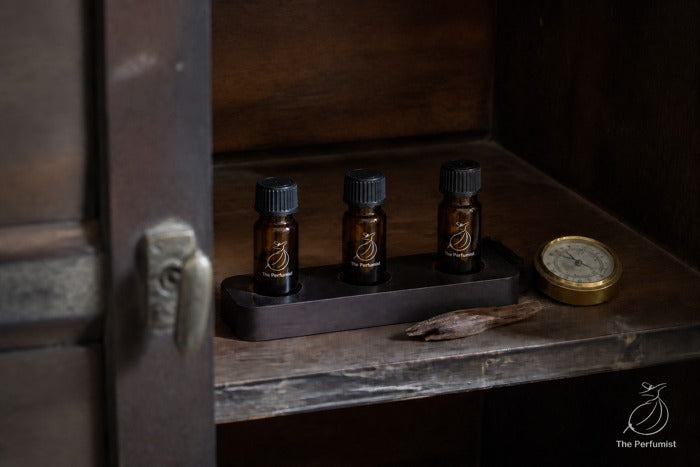
I keep wood-oil samples tightly closed and away from heat and direct light between comparisons. A dark bottle is useful packaging, but it does not prove authenticity or quality. The contents still need a clear description and a fair smell test; this unlabelled bottle illustrates storage rather than identifying an oud or sandalwood oil.

I compare the application format as well as the wood note. A roller deposits a small amount over a limited patch, while a spray distributes fragrance more widely. That difference can make a sandalwood oil seem quieter than an oud spray even when the fragrance choice is not the only reason.

From material to perfume
Distillation equipment illustrates a method, not the identity of what passed through it. A photograph of glassware cannot prove that a bottle is pure oud or sandalwood oil. I separate questions about processing from questions about declared ingredients and documented origin.

Heat, vapour and condensation belong to an extraction process; the smell in a finished perfume also depends on the formula that follows. I do not judge oud against sandalwood from a dramatic equipment photograph. I compare the actual samples and their clear descriptions.

Historical copper apparatus gives context to aromatic extraction, but it is not a photograph of either wood being processed here. It reminds me to distinguish an educational display from production evidence. The perfume’s character still has to be assessed in the sample.

Preparation is part of a raw material’s story, but a tray of wood cannot establish its species, treatment or eventual aroma. When those details influence a purchase, I ask for documentation. I do not infer a guaranteed oud or sandalwood quality from a picturesque processing scene.

When I compare an oud-led accord with a sandalwood-led one, the amount matters as much as the material. A small addition can alter the balance of a trial blend; judging two mixtures at very different strengths can make the louder one seem better. The photograph shows generic perfume preparation, not a particular oud formula or our own workshop.

I keep comparison samples separate during transfer. Residue from an oud blend can overwhelm a softer sandalwood sample, so clean dedicated glassware matters when preparing a fair side-by-side evaluation. A funnel helps guide liquid into a narrow opening; it does not tell us what material the bottle contains.

The name of a wood is only the beginning of a perfume brief. I would describe the intended balance as well: a softer sandalwood-led result, a darker oud-led result, or a composition that keeps both recognisable. Written comparisons make these choices clearer than repeatedly adding material without a record.

Choosing between the finished fragrances
For an everyday choice, I return to the finished fragrance rather than the prestige of either wood. I ask whether I enjoy its settled smell, how noticeable I want it to be, and whether I still like it after several wears. Oud and sandalwood are useful starting points, not rankings.

-Ali Attar