Visit our Library and download Free exclusive e-books — click to discover and begin reading.
Kinam Oil Lab Test - Certification
Quote#: UNS100521-03
Testing Results for: The Perfumist
Ali Attar
Info@theperfumist.com
Testing Results for: The Perfumist
Ali Attar
Info@theperfumist.com
UnivarSolutions
CONFIDENTIAL TESTING REPORT
The Perfumist
Prepared by:
Univar Solutions
1646 Rankin Rd, Suite 100
Houston, TX 77073
CustomLabServices@univarsolutions.com
281.982.9447
Date: 10/27/2021
Quote#: UNS100521-03
Testing Results for: The Perfumist
2
Testing Results for: The Perfumist
2
UnivarSolutions
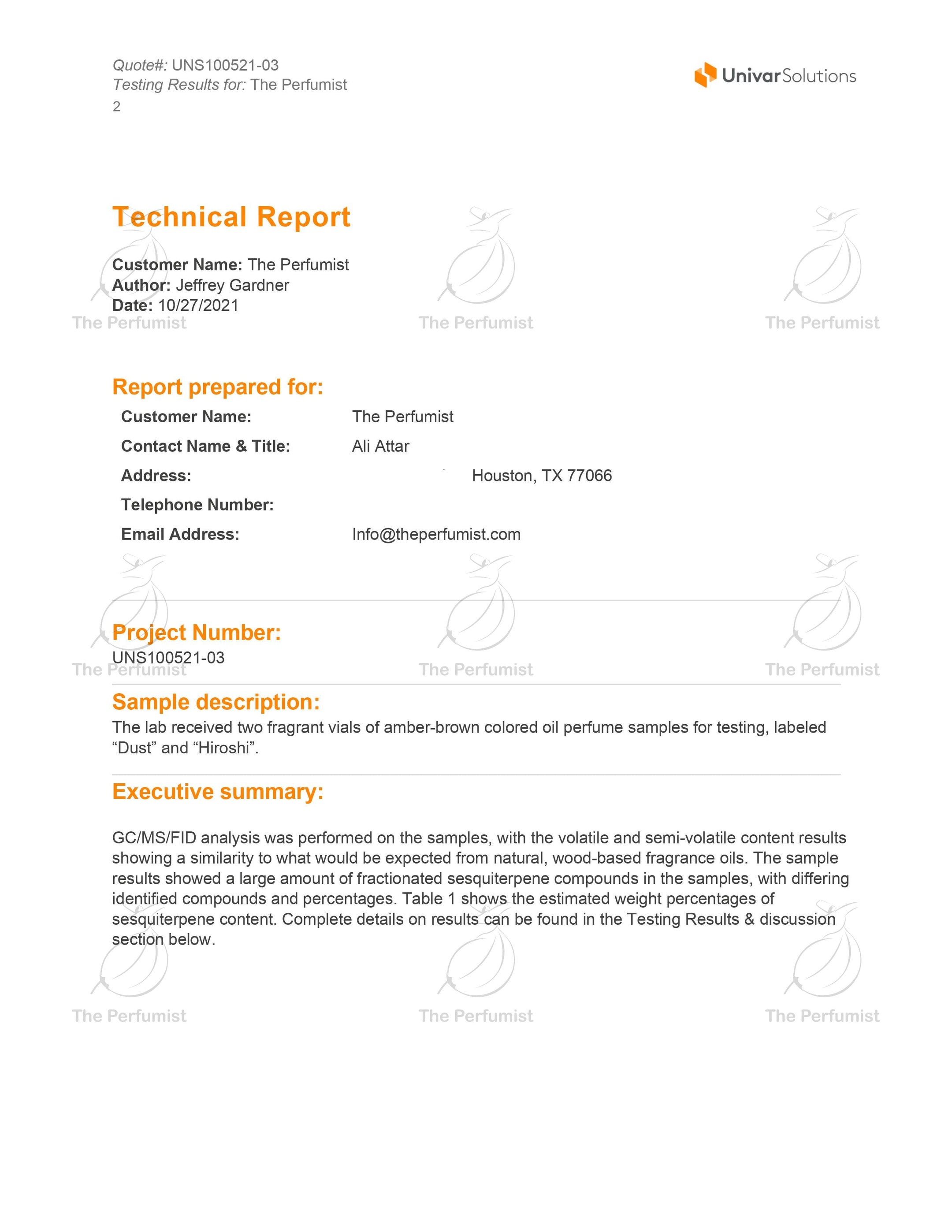
Technical Report
Customer Name: The Perfumist
Author: Jeffrey Gardner
Date: 10/27/2021
Report prepared for:
Customer Name: The Perfumist
Contact Name & Title: Ali Attar
Address: Houston, TX 77066
Telephone Number:
Email Address: Info@theperfumist.com
Project Number:
UNS100521-03
Sample description:
The lab received two fragrant vials of amber-brown colored oil perfume samples for testing, labeled “Dust” and “Hiroshi”.
Executive summary:
GC/MS/FID analysis was performed on the samples, with the volatile and semi-volatile content results showing a similarity to what would be expected from natural, wood-based fragrance oils. The sample results showed a large amount of fractionated sesquiterpene compounds in the samples, with differing identified compounds and percentages. Table 1 shows the estimated weight percentages of sesquiterpene content. Complete details on results can be found in the Testing Results & discussion section below.
Quote#: UNS100521-03
Testing Results for: The Perfumist
3
Testing Results for: The Perfumist
3
UnivarSolutions
| Component | Dust Estimated Weight (wt%) |
Hiroshi Estimated Weight (wt%) |
|---|---|---|
| Sesquiterpene wt/wt% | 88-89% | 70-71% |
| Highest Abundance Compounds |
Agarospirol (10-11%) | α-Cedrene (12-13%) |
Introduction:
To identify and determine the semi-quantitative concentrations for the volatile and semi-volatile components in the samples using GC/MS/FID analysis.
Testing methods:
GC/MS/FID Analysis
A 1:200 w/w dilution of sample in methanol was prepared, using a vortex mixer to homogenize the aliquot. The aliquot was then filtered through a 0.45 μL syringe filter to remove solid particles. Analysis on the dilution was performed on an Agilent 7890B GC equipped with a 5977A MSD, with a FID detector. A 1 μL injection was used at a 1:20 inlet split ratio onto a Rxi-5ms column (30m x 0.25 mm x 0.25 μm). Semi-quantitation of all volatile and semi-volatile components was performed by comparing the area of a limonene internal standard with the area of the peaks of the sample. Please note that the values reported are semi-quantitative approximations and require standards of each compound for more exact quantitation. Identification of all compounds was performed using the NIST Library.
Testing Results & discussion:
GC/MS/FID
Tables 2 and 3 summarize the identification and semi-quantitation results for the volatile and semi-volatile components of the Dust and Hiroshi samples, respectively, while Figures 1 and 2 show their Flame Ionization Detector (FID) chromatograms. Important to note is that limonene is an internal standard, and therefore is not a component of the samples.
Quote#: UNS100521-03
Testing Results for: The Perfumist
4
Testing Results for: The Perfumist
4
UnivarSolutions
| Peak | Retention Time (Min.) |
NIST Identification | Semi- Quantitation (Weight %) |
|---|---|---|---|
| 1 | 7.557 | Limonene (Internal Standard) | * |
| 2 | 10.855 | 2-Butanone, 4-phenyl- | 2.171 |
| 3 | 14.007 | Aromatic Sesquiterpene | 3.530 |
| 4 | 14.116 | π 8-epi-.gama.-eudesmol | 0.401 |
| 5 | 14.223 | 2-Butanone, 4-(4-methoxyphenyl)- | 0.549 |
| 6 | 14.258 | Patchoulene | 0.221 |
| 7 | 14.342 | Dihydro-β-agarofuran (Sesquiterpene) | 0.245 |
| 8 | 14.361 | Dihydro-β-agarofuran (Sesquiterpene) | 0.625 |
| 9 | 14.421 | Dihydro-β-agarofuran (Sesquiterpene) | 0.270 |
| 10 | 14.518 | Patchoulene (Sesquiterpene) | 0.497 |
| 11 | 14.744 | Cadinene (Sesquiterpene) | 0.479 |
| 12 | 14.829 | γ-Selinene (Sesquiterpene) | 0.286 |
| 13 | 14.867 | α-Acorenol (Sesquiterpene) | 0.217 |
| 14 | 14.907 | Alloaromadendrene oxide (Sesquiterpene) | 0.922 |
| 15 | 15.061 | Aromatic Oxygenated Sesquiterpene | 1.593 |
| 16 | 15.117 | Dihydro-β-agarofuran (Sesquiterpene) | 0.299 |
| 17 | 15.21 | Aromatic Oxygenated Sesquiterpene | 0.232 |
| 18 | 15.363 | Aromatic Oxygenated Sesquiterpene | 0.195 |
| 19 | 15.433 | Aromadendrene oxide (Sesquiterpene) | 0.387 |
| 20 | 15.503 | Aromatic Oxygenated Sesquiterpene | 0.915 |
| 21 | 15.575 | Aromatic Oxygenated Sesquiterpene | 0.346 |
| 22 | 15.626 | Aromatic Sesquiterpene | 0.192 |
| 23 | 15.705 | β-Guaiene (Sesquiterpene) | 0.808 |
| 24 | 15.764 | 8-epi-.gama.-eudesmol (Sesquiterpene) | 6.672 |
| 25 | 15.872 | γ-Eudesmol (Sesquiterpene) | 3.190 |
| 26 | 15.925 | Agarospirol (Sesquiterpene) | 12.639 |
| 27 | 16.031 | α-Gurjunene (Sesquiterpene) | 9.187 |
| 28 | 16.118 | Guaiol (Sesquiterpene) | 10.423 |
| 29 | 16.196 | β-Guaiene (Sesquiterpene) | 1.246 |
| 30 | 16.343 | α-Copaen-11-ol (Sesquiterpene) | 3.268 |
| 31 | 16.403 | Naphthalene-Based Sesquiterpene | 2.526 |
| 32 | 16.588 | Aromadendrene oxide (Sesquiterpene) | 0.976 |
| 33 | 16.659 | Acetic Acid-Based Sesquiterpene | 2.068 |
| 34 | 16.696 | Naphthalene-Based Sesquiterpene | 1.657 |
| 35 | 16.772 | β-Guaiene (Sesquiterpene) | 0.558 |
| 36 | 16.832 | 5β,7βH,10α-Eudsen-11-en-1α-ol | 1.009 |
| 37 | 16.856 | Calarene epoxide (Sesquiterpene) | 0.608 |
Quote#: UNS100521-03
Testing Results for: The Perfumist
5
Testing Results for: The Perfumist
5
UnivarSolutions
| 38 | 16.973 | Aromadendrene oxide (Sesquiterpene) | 1.095 |
| 39 | 17.038 | Naphthalene-Based Sesquiterpene | 1.063 |
| 40 | 17.098 | Isoaromadendrene epoxide (Sesquiterpene) | 0.391 |
| 41 | 17.2 | Naphthalene-Based Sesquiterpene | 4.426 |
| 42 | 17.254 | γ-Gurjuneneepoxide-(2) (Sesquiterpene) | 2.170 |
| 43 | 17.336 | Acetic Acid-Based Sesquiterpene | 1.530 |
| 44 | 17.427 | γ-Gurjuneneepoxide (Sesquiterpene) | 0.630 |
| 45 | 17.506 | β-Vatirenene (Sesquiterpene) | 0.806 |
| 46 | 17.557 | Acetic Acid-Based Sesquiterpene | 1.306 |
| 47 | 17.65 | γ-Gurjuneneepoxide (Sesquiterpene) | 0.869 |
| 48 | 17.727 | Naphthalene-Based Sesquiterpene | 0.467 |
| 49 | 17.846 | Naphthalene-Based Sesquiterpene | 1.051 |
| 50 | 18.071 | Methyl linokiate (Sesquiterpene) | 0.688 |
| 51 | 18.154 | Aromatic Sesquiterpene | 0.216 |
| 52 | 18.194 | Acetic Acid-Based Sesquiterpene | 0.598 |
| 53 | 18.343 | Acetic Acid-Based Sesquiterpene | 1.407 |
| 54 | 18.825 | 12,15-Octadecadienoic acid, methyl ester | 0.682 |
| 55 | 19.388 | Spiro-Based Sesquiterpene | 0.486 |
| 56 | 21.012 | n-Hexadecanoic acid | 4.465 |
| 57 | 21.118 | Cedran-diol, 8S;13- (Sesquiterpene) | 0.729 |
| 58 | 23.587 | 1-Heptatriacotanol | 1.721 |
| 59 | 23.795 | n-Hexadecanoic acid | 0.613 |
| 60 | 23.937 | Spiro-Based Sesquiterpene | 0.264 |
| 61 | 25.233 | 9-Octadecenamide | 0.618 |
| 62 | 26.354 | Functionalized Propanedioic acid | 0.276 |
Figure 1: FID Chromatogram of Dust
Quote#: UNS100521-03
Testing Results for: The Perfumist
6
Testing Results for: The Perfumist
6
UnivarSolutions
| Peak | Retention Time (Min.) |
NIST Identification | Semi- Quantitation (Weight %) |
|---|---|---|---|
| 1 | 7.56 | Limonene (Internal Standard) | * |
| 2 | 12.464 | Naphthalene-Based Sesquiterpene | 0.234 |
| 3 | 12.769 | Selinan (Sesquiterpene) | 0.499 |
| 4 | 12.81 | Aromatic Oxygenated Sesquiterpene | 0.673 |
| 5 | 12.875 | Copaene (Sesquiterpene) | 0.616 |
| 6 | 12.957 | Naphthalene-Based Sesquiterpene | 0.145 |
| 7 | 13.074 | β-Patchoulene (Sesquiterpene) | 0.313 |
| 8 | 13.249 | α-Cedrene (Sesquiterpene) | 12.294 |
| 9 | 13.318 | Caryophyllene (Sesquiterpene) | 0.557 |
| 10 | 13.361 | β-Cedrene (Sesquiterpene) | 2.777 |
| 11 | 13.478 | Thujopsene (Sesquiterpene) | 0.924 |
| 12 | 13.573 | Selinan (Sesquiterpene) | 0.300 |
| 13 | 13.671 | α-Cedrane (Sesquiterpene) | 1.635 |
| 14 | 13.754 | Acoradien (Sesquiterpene) | 0.134 |
| 15 | 13.868 | Aromatic Sesquiterpene | 0.198 |
| 16 | 13.893 | Acoradien (Sesquiterpene) | 0.345 |
| 17 | 14.013 | Cedren-13-ol, 8- (Sesquiterpene) | 0.934 |
| 18 | 14.075 | β-Chamigrene (Sesquiterpene) | 0.128 |
| 19 | 14.112 | Selinan (Sesquiterpene) | 0.670 |
| 20 | 14.16 | Leden (Sesquiterpene) | 0.158 |
| 21 | 14.254 | Guaia-1(10),11-diene (Sesquiterpene) | 0.720 |
| 22 | 14.359 | Chamigren (Sesquiterpene) | 0.491 |
| 23 | 14.39 | Cuparene (Sesquiterpene) | 0.747 |
| 24 | 14.466 | γ-Cadinene (Sesquiterpene) | 0.218 |
| 25 | 14.526 | Naphthalene-Based Sesquiterpene | 1.296 |
| 26 | 14.549 | δ-Cadinene (Sesquiterpene) | 1.555 |
| 27 | 14.683 | γ-Selinene (Sesquiterpene) | 0.176 |
| 28 | 14.746 | α-Calacorene (Sesquiterpene) | 0.190 |
| 29 | 14.815 | α-Calacorene (Sesquiterpene) | 0.371 |
| 30 | 14.877 | 8-Cedrene-13-ol (Sesquiterpene) | 6.772 |
| 31 | 14.957 | Naphthalene-Based Sesquiterpene | 0.166 |
| 32 | 15.066 | Muroilan-3,9(11)-diene-10-peroxy (Sesquiterpene) | 0.117 |
| 33 | 15.144 | 1,2-Longidione (Sesquiterpene) | 0.084 |
| 34 | 15.186 | Caryophyllenyl alcohol (Sesquiterpene) | 0.120 |
| 35 | 15.259 | Aromadendrene oxide (Sesquiterpene) | 0.157 |
| 36 | 15.299 | Gleenol (Sesquiterpene) | 0.223 |
Quote#: UNS100521-03
Testing Results for: The Perfumist
7
Testing Results for: The Perfumist
7
UnivarSolutions
| 37 | 15.448 | Aromatic Oxygenated Sesquiterpene | 0.271 |
| 38 | 15.557 | Naphthalene-Based Sesquiterpene | 1.090 |
| 39 | 15.591 | Cedrol (Sesquiterpene) | 9.934 |
| 40 | 15.676 | Cubenol (Sesquiterpene) | 0.383 |
| 41 | 15.746 | Aromatic Oxygenated Sesquiterpene | 0.444 |
| 42 | 15.815 | Calarene epoxide (Sesquiterpene) | 1.048 |
| 43 | 15.867 | γ-Eudesmol (Sesquiterpene) | 2.686 |
| 44 | 15.959 | Cedrelanol (Sesquiterpene) | 1.219 |
| 45 | 16.06 | α-Copaene-11-ol (Sesquiterpene) | 1.015 |
| 46 | 16.108 | β-Eudesmol (Sesquiterpene) | 1.672 |
| 47 | 16.128 | α-Eudesmol (Sesquiterpene) | 2.167 |
| 48 | 16.215 | Globulol (Sesquiterpene) | 2.371 |
| 49 | 16.34 | α-Copaen-11-ol (Sesquiterpene) | 0.810 |
| 50 | 16.391 | α-Acorenol (Sesquiterpene) | 0.960 |
| 51 | 16.489 | Isoaromadendrene epoxide (Sesquiterpene) | 0.681 |
| 52 | 16.643 | Alloaromadendrene oxide (Sesquiterpene) | 0.165 |
| 53 | 18.178 | Retinol (Diterpene) | 0.460 |
| 54 | 18.592 | Isolongifolene, 4,5,9,10-dehydro- (Sesquiterpene) | 0.157 |
| 55 | 19.446 | Retinol (Diterpene) | 0.519 |
| 56 | 19.637 | Dehydroisoandrosternone acetate | 0.368 |
| 57 | 20.017 | Retinol (Diterpene) | 0.226 |
| 58 | 20.18 | Sclarene | 1.416 |
| 59 | 20.615 | Pisiferol (Abietane Diterpenoid) | 10.907 |
| 60 | 20.98 | Estra-1,3,5(10)-trien-17β-ol | 0.751 |
| 61 | 21.243 | Aromatic Oxygenated Sesquiterpene | 0.212 |
| 62 | 21.433 | Retinol (Diterpene) | 0.329 |
| 63 | 21.626 | Alloaromadendrene oxide (Sesquiterpene) | 0.160 |
| 64 | 21.914 | Sclareol (Diterpene) | 0.273 |
| 65 | 22.257 | Manoyl oxide | 0.474 |
| 66 | 22.33 | Acetic Acid-Based Sesquiterpene | 0.292 |
| 67 | 22.641 | Kaur-16-ene (Diterpene) | 0.664 |
| 68 | 22.737 | Aromatic Oxygenated Diterpene | 0.626 |
| 69 | 22.806 | Retinol (Diterpene) | 1.136 |
| 70 | 22.959 | Alloaromadendrene oxide | 0.506 |
| 71 | 23.126 | Cembrene (Diterpene) | 0.812 |
| 72 | 23.218 | Androst-5,7,9(11)-triene, 3-acetoxy-17-oxo- | 0.319 |
| 73 | 23.277 | Aromatic Oxygenated Sesquiterpene | 0.085 |
| 74 | 23.373 | Aromatic Oxygenated Diterpene | 0.149 |
| 75 | 23.475 | Retinol, acetate (Diterpene) | 0.529 |
Quote#: UNS100521-03
Testing Results for: The Perfumist
8
Testing Results for: The Perfumist
8
UnivarSolutions
| 76 | 23.504 | Retinol (Diterpene) | 1.094 |
| 77 | 23.542 | Aromatic Oxygenated Diterpene | 0.696 |
| 78 | 23.605 | Functionalized phenanthrenecarboxylic acid | 0.497 |
| 79 | 23.848 | Retinol, acetate (Diterpene) | 3.030 |
| 80 | 23.868 | Retinol (Diterpene) | 0.813 |
| 81 | 23.931 | Naphthalene-Based Sesquiterpene | 1.840 |
| 82 | 24.128 | Retinal, 9-cis- (Diterpene) | 0.656 |
| 83 | 24.387 | Retinoic acid (Diterpene) | 0.231 |
| 84 | 24.479 | Retinoic acid (Diterpene) | 0.139 |
| 85 | 24.526 | Cembrene (Diterpene) | 0.263 |
| 86 | 24.718 | Aromatic Oxygenated Sesquiterpene | 2.985 |
| 87 | 24.786 | Aromatic Oxygenated Sesquiterpene | 0.830 |
| 88 | 24.82 | Aromatic Oxygenated Hydrocarbon | 0.110 |
| 89 | 24.878 | Retinal, 9-cis- (Diterpene) | 0.422 |
| 90 | 24.978 | Aromatic Oxygenated Hydrocarbon | 0.198 |
| 91 | 25.132 | Aromatic Oxygenated Hydrocarbon | 0.244 |
| 92 | 25.235 | cis-9,10-Epoxyoctadecanamide | 0.422 |
| 93 | 26.348 | Aromatic Oxygenated Diterpene | 0.155 |
Figure 2: FID Chromatogram of Hiroshi
Thank you for using the services at Univar Solutions’ Houston Formulation and Testing Lab. Please feel free to contact me at any time in regard to this report or any additional future project work. We look forward to working with you again.
Quote#: UNS100521-03
Testing Results for: The Perfumist
9
Testing Results for: The Perfumist
9
UnivarSolutions
Reviewed by:
Erin E. Burke, Ph.D.
10/27/2021
Erin E. Burke, Ph.D. | Technical Manager-Lab Services Date
Legal disclaimer:
The information in this report and associated documents has been provided by Univar Solutions USA Inc. (“Univar Solutions”). Although the statements, technical information and recommendations are believed to be accurate, UNIVAR SOLUTIONS EXPRESSLY DISCLAIMS ANY AND ALL LIABILITY, EITHER EXPRESS OR IMPLIED arising from any use of the products or reliance on any information provided herein. This information is based on many factors beyond Univar Solutions’ control, including but not limited to the completeness and accuracy of information received, or the conditions prevailing when operations were observed and/or sampled. In choosing to rely on or use this information, you assume all risks relating to the results obtained and agree to indemnify Univar Solutions against any and all claims. All recommendations or suggestions must be evaluated by you to determine their applicability or suitability for your particular uses. Univar Solutions is not engaged in rendering legal or other professional services and if such services are required, you should retain a competent professional to provide them. Any information claimed by Univar Solutions to be confidential or proprietary is not to be disclosed to any third party. Nothing contained herein constitutes a license to practice under any patent and should not be construed as an inducement to infringe on any patent.
10.27.2021
Letter of certification for
Kinam/Kyara oil.
#1111-2-10-28-2021
Regarding Lab test
#JNS100521-03
Kinam/Kyara oil.
#1111-2-10-28-2021
Regarding Lab test
#JNS100521-03
LETTER OF CERTIFICATION – KINAM/ KYARA
Greetings,
Kinam/Kyara is a word describing a specific kind of agarwood with unique constituents, making it one of the rarest materials in the world. While there are many theories about how, where, and why it exists, many aspects are still a mystery. A little search and understanding of the kinam/Kyara History are necessary to understand the full depth and significance of kinam/kyara. Some of the scientific research and references are listed below.
I won’t go into the full details here. My object is to clarify and explain the findings and describe what we assume as kinam/ Kyara oils that we will be offering exclusively in The Perfumist. The word Kinam/kyara has been used and abused by many companies and adds unrealistic value to some of the companies’ oils.
Like any piece of art, it’s essential to track and know its history, which is the first step we use in certifying the oils. Those specific kinam/kyara oils we are offering are fully traceable, and we can track with high accuracy who owned it, when, and where.
The second step is the testing, and we have tested the following oils in an independent lab, and an independent botanist has further evaluated the constituents and findings.
The third step is assessing the oils by scent and profile multiple times as eventually, this will be the main point of judgment.
While the name kinam/kyara is used to describe wood and not oils, it is physically impossible to distill a 100% pure kinam/kyara oil from that wood because of the cost and the actual existing quantities of wood itself.
So, when we assume or presume an oil is, or call it kinam/Kyara oil, we are simply marking and finding similarities and resemblances of this oil with the wood in the matter of scent, profile, and constituents. So, in other words, and for all accuracy, there is “NO OIL IN THE WORLD THAT IS SCIENTIFICALLY PROVEN OR FOUND TO BE KINAM/KYARA.” But there are very old and extremely rare and high-quality oils that have been distilled from specific woods by specialized masters that have resemblance and similarities with the kinam wood, and that is what is offered here.
The majority of those oils throughout history were restricted to very few people, and most of those oils nowadays are entirely extinct. So those are the only two oils we have in our collection that reassembles the true kinam/kyara scent, which is undoubtedly the crown jewels of any collection. Those oils have been passed down in generations, and we are both honored and privileged to be able to offer them to the world.
Ali Attar
Owner / Master Perfumist
info@theperfumist.com
www.theperfumist.com